Characterization of the pH-Dependent Stabilizing Forces of Insulin’s Native and Fibril States
Stefan Hervø-Hansen, Nobuyuki Matubayasi
June, 2026
Abstract
Insulin fibrillation poses a major challenge for protein therapeutics, yet the molecular origins of its strong pH dependence remain incompletely understood. Here we employ constant-pH molecular dynamics simulations to quantify residue-specific protonation behavior in native monomeric insulin and in fibrils of increasing size. While the native monomer exhibits largely uncoupled titration with modest pKa perturbations, conversion to the fibrillar fold induces systematic upshifts of acidic residues driven by partial desolvation and reduced dielectric screening. Upon self-association, strong electrostatic coupling emerges between neighboring glutamate residues aligned along the fibril axis, giving rise to cooperative and multistep titration behavior. In fibril assemblies, central residues consistently deprotonate first, despite residing in partially solvent-shielded environments within the fibril core, indicating that collective electrostatic frustration overrides simple solvent accessibility effects. This cooperative charge redistribution is accompanied by a progressive loss of intermonomer contacts, revealing pH-dependent weakening of fibril cohesion. Together, our results demonstrate that insulin fibrillation is governed by collective electrostatics that arises only after conformational rearrangement and assembly, providing an atomistic framework for understanding pH-regulated amyloid stability.
Publication
In ACS Physical Chemistry Au

Specially Appointed Researcher
My research interests include molecular simulation methods, free energy calculations, and rational macromolecular design.
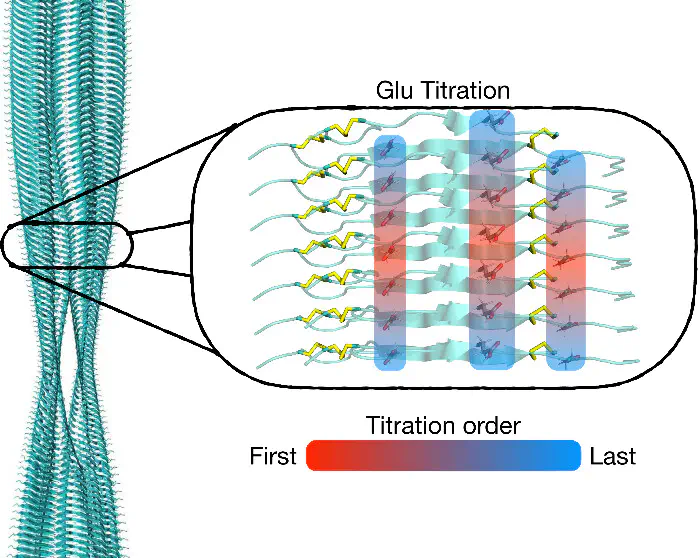 Image credit: J. Chem. Theory Comput.